

Case study
5G-Enabled Wireless XR Training System
Helped bring Tabletop Commander, CloudXR remote rendering, and a local 5G network together through onsite collaboration with NVIDIA and the wider engineering team, with custom headset provisioning.
XR application development, streaming integration, and headset provisioning · Booz Allen Hamilton
On Booz Allen's 5G/XR team, I contributed to the integration of three connected parts: the Tabletop Commander Unity application, the CloudXR remote-rendering stack, and the local 5G network. I helped develop the application and worked onsite with NVIDIA's CloudXR team and other engineers to bring the application, rendering servers, and headset clients together.
- Application work: Helped develop Tabletop Commander, a Unity application giving soldiers a battlefield overview.
- Systems integration: Worked onsite with NVIDIA and the wider engineering team to connect Tabletop Commander, CloudXR remote rendering, and the local 5G network.
- Device tooling: Built a custom headset-management system and headset APK for device registration and XR server configuration.
Connecting the Application, Network, and Devices
The core integration connected Tabletop Commander to the CloudXR remote-rendering stack, with the local 5G network carrying the streamed experience to headset clients. My work spanned those application, rendering, and network boundaries. Alongside that integration, I built the device-management tooling for headset registration and server configuration.
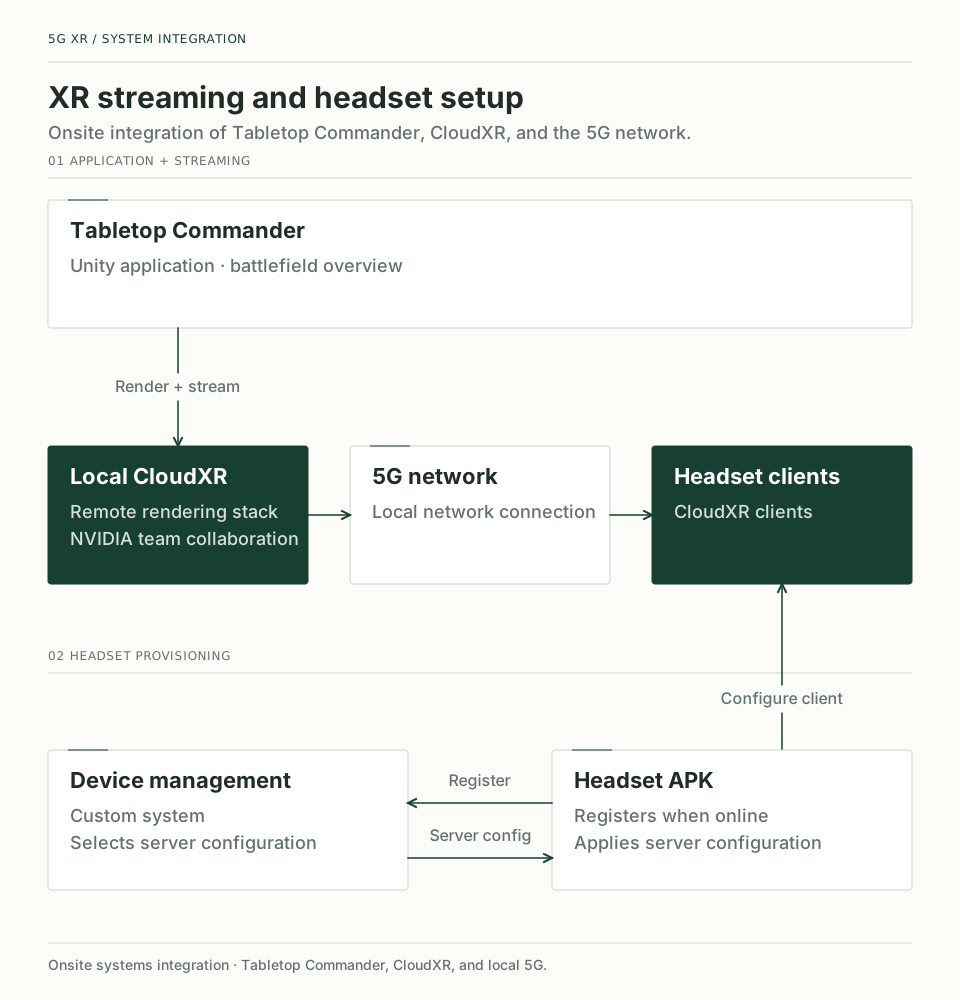
Simplified view of the application, streaming, and device-provisioning work I contributed to the broader program.
The Challenge
Wireless XR training requires the application, server, network, and headset to work as one experience. An application can be functional on its own while still needing substantial integration before it can run through a streaming system on a configured headset.
My work connected those parts in the local 5G environment. This involved application development alongside partner integration and device tooling, with engineers and stakeholders working through the same system from different perspectives.
Building the Training Application
I helped develop Tabletop Commander, a Unity application that gives soldiers a battlefield overview. This application work sat alongside my contribution to getting the experience streamed to headsets through the local CloudXR and 5G setup.
The broader program's public account describes Tabletop Commander being used for mission planning and reconnaissance, including access to geographic information system data. My own scope was contributing to the application and its integration with the rendering and network environment.
Bringing CloudXR Into the Local 5G Environment
I worked closely with NVIDIA's CloudXR team to stand up local rendering servers and headset clients, connect them with the local 5G network, and enable streaming for Tabletop Commander. The work involved making the application, remote-rendering stack, and network operate together as an experience on the headset.
I worked onsite at the 5G facility alongside engineers, partner integrators, and client stakeholders, including program leadership. The work required hands-on coordination across the application and infrastructure pieces.
| Technical decision | Purpose |
|---|---|
| Connect Tabletop Commander to the CloudXR remote-rendering stack | Deliver the Unity application as a streamed headset experience. |
| Stand up local CloudXR servers and clients with NVIDIA's team | Integrate remote rendering with the local 5G network. |
| Provision server configuration through a custom management system | Connect headset registration to the XR server setup each device needed. |
A Headset Lifecycle Built Into the Tooling
I built the headset-management system and a headset APK to handle registration and provisioning:
- Come online: The headset entered the connected environment.
- Register: The headset APK registered the device with the management system.
- Receive configuration: The system provisioned the correct XR server configuration for that headset.
This made device setup part of the integrated system, alongside the application and streaming infrastructure.
What the Work Delivered
My contributions brought together Tabletop Commander development, CloudXR remote rendering, local 5G integration, and device provisioning. Working onsite with NVIDIA, partner engineers, and client stakeholders was central to connecting those parts within the wider wireless XR effort.
Booz Allen's public account documents the integrated program's field tests at Fort Cavazos in October 2023. It credits a broader system combining training applications, headsets, servers, and 5G networking—the program context for my hands-on engineering work.
Read Booz Allen's account of the wireless XR training program.